- Do you like your hair? We have a live and let live relationship, more or less.
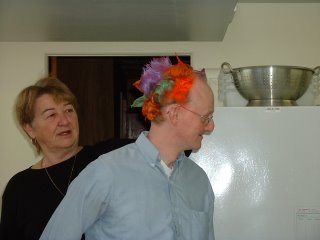
- Have you ever colored your hair? If not, would you consider it? Permanently? no. But many times for shows (including hot pink when I played Cupid once -- that was a costume to defy description). ANd then there was the year I promised to let the congregation colour my hair should they meet or beat their Mission and Service Fund Pledge. THey had a ball.
- What's the longest you've ever worn your hair? The shortest? Generally I get my hair cut "just long enough that it still lies down". The longest is probably almost to my collar (when it was a long time before I got around to getting it cut again).
- When and what was your worst. haircut. ever? In the 80's I was convinced to get the sides feathered. My hair has natural wave so the feathers had quite a flip to them. I hated it (although many people said they would love to have that little flip).
- Tell us a favorite song or scene from a book or movie dealing with hair. As someone whose hairline is "migrating" I do appreciate Homer Simpson's ongoing obsession with his hair. Oh and the time in Reba when Van's teammates tricked him into shaving his head and Elizabeth would not come near him -- that whole episode had some good lines and images.
Friday, March 10, 2006
RGBP Friday Five -- Hair


Thursday, March 09, 2006
THis is Sad
Heard this story on the news last night (while killing time at the airport actually) and read it in tonight's paper. Unfortunately I can't find a link to the story online -- might not have hit the rigth search string yet.
(Background: Every year the Tim Horton's Chain has a RRRRRRRRoll-Up-the-RRRRRRRRRRim-to-win promotion)
A Grade 5 student found an empty Tim Horton's cup at her school and tried to roll up the rim. When she had difficulty she asked an older friend to help. The cup was a winning one, which won a Toyota Rav4. But then it got murky.
THe family of the second girl, thinking that they deserved something, phoned a radio station seeking legal advice (why would anyone phone a radio station for legal advice???). Now the families are fighting over the car.
What does this teach these pre-teens? What message about sharing and rejoicing in each other's good fortune is there here?
(Background: Every year the Tim Horton's Chain has a RRRRRRRRoll-Up-the-RRRRRRRRRRim-to-win promotion)
A Grade 5 student found an empty Tim Horton's cup at her school and tried to roll up the rim. When she had difficulty she asked an older friend to help. The cup was a winning one, which won a Toyota Rav4. But then it got murky.
THe family of the second girl, thinking that they deserved something, phoned a radio station seeking legal advice (why would anyone phone a radio station for legal advice???). Now the families are fighting over the car.
What does this teach these pre-teens? What message about sharing and rejoicing in each other's good fortune is there here?
Tuesday, March 07, 2006
When More is Never Enough (Newspaper Column)
We live in a world of contradiction. On the one hand, we have more than any other generation. On the other, we have convinced ourselves that we need just that little bit more to be happy, to have “enough”.
Really, it’s true. Between 1951 and 1996 the average income of the Canadian family (in constant 1996 dollars) grew from $22 743 to $56 600 – an increase of almost 250%. What we now consider a small house for a couple would once have been home to a family of four or five. Most families had one vehicle, now most have at least two. TV’s, once a luxury item, are now standard parts of life – with many families having two or three sets. The list goes on. And yet, in the midst of all this abundance, people are desperately unhappy. The number of prescriptions written for depression and anxiety continues to grow. People complain of having no time, of feeling run off their feet. People wonder about a sense of meaning and purpose.
In reality this is not new. Rabbi Harold Kushner suggests that the writer of Ecclesiastes suffered this same disconnect. He had everything but he had nothing, and so he says: “vanity of vanities! All is vanity.” Eventually the writer turns to God. There he finds a sense of purpose and meaning that had been missing. It is telling that Kushner discusses this in his book titled When All You Ever Wanted Isn’t Enough.
The problem in our society is that often we fail to see the abundance around us. Instead we believe the myth of scarcity, the myth that we need more. This is probably news to nobody, but happiness doesn’t come from a store. The scarcity myth, brought to us largely by the advertising industry and our own fear of inadequacy, drives us to keep buying until we are either happy or broke. But there is another way.
The other way to happiness involves first stepping off the treadmill to look at what we have. Then we can ask why we think we need more, or what it is we truly need. People who are happy are people who feel that their lives have purpose. People who are happy are people who are connected to something beyond themselves. For some that something bigger is found in the community. For many that something bigger is found in faith, in spirituality, in religion. Coincidentally, Christian faith leads us directly to becoming involved in improving the life of our community which can reinforce that sense of purpose and contentment we are looking for.
We can continue to live with the contradiction of having lots but wanting more and still not being content. Or we can choose to look to faith for the true source of contentment. We can choose to be settled in our abundance, an abundance both of things from the marketplace and of those things you can never buy – family, friends, community. God is calling us to the second choice, which will we make?
Really, it’s true. Between 1951 and 1996 the average income of the Canadian family (in constant 1996 dollars) grew from $22 743 to $56 600 – an increase of almost 250%. What we now consider a small house for a couple would once have been home to a family of four or five. Most families had one vehicle, now most have at least two. TV’s, once a luxury item, are now standard parts of life – with many families having two or three sets. The list goes on. And yet, in the midst of all this abundance, people are desperately unhappy. The number of prescriptions written for depression and anxiety continues to grow. People complain of having no time, of feeling run off their feet. People wonder about a sense of meaning and purpose.
In reality this is not new. Rabbi Harold Kushner suggests that the writer of Ecclesiastes suffered this same disconnect. He had everything but he had nothing, and so he says: “vanity of vanities! All is vanity.” Eventually the writer turns to God. There he finds a sense of purpose and meaning that had been missing. It is telling that Kushner discusses this in his book titled When All You Ever Wanted Isn’t Enough.
The problem in our society is that often we fail to see the abundance around us. Instead we believe the myth of scarcity, the myth that we need more. This is probably news to nobody, but happiness doesn’t come from a store. The scarcity myth, brought to us largely by the advertising industry and our own fear of inadequacy, drives us to keep buying until we are either happy or broke. But there is another way.
The other way to happiness involves first stepping off the treadmill to look at what we have. Then we can ask why we think we need more, or what it is we truly need. People who are happy are people who feel that their lives have purpose. People who are happy are people who are connected to something beyond themselves. For some that something bigger is found in the community. For many that something bigger is found in faith, in spirituality, in religion. Coincidentally, Christian faith leads us directly to becoming involved in improving the life of our community which can reinforce that sense of purpose and contentment we are looking for.
We can continue to live with the contradiction of having lots but wanting more and still not being content. Or we can choose to look to faith for the true source of contentment. We can choose to be settled in our abundance, an abundance both of things from the marketplace and of those things you can never buy – family, friends, community. God is calling us to the second choice, which will we make?
Monday, March 06, 2006
BAptism
In my series of sermons about the church we come to Baptism this week. Here is a snippet from my opening thoughts (more found here)
But for me the most important part of the baptism service is the two promises. One is the promise by the parents to share the faith. The other is the promise by the congregation to be there to help/support/guide in that sharing of the faith. Many congregations I have been in are very quick to complain about parents failing to live up to their promise, to talk about how we see them at baptism but rarely (or never) again. But I have to ask, how good are our congregations at living up to their promise? Is it enough to say, "we are here" and "we have a SUnday School program"? SOme congregations name a sponsor to be there for the family, a contact point as it were. But does that make much difference? How do we all live out the promises we make at baptism to raise our children with a knowledge of God made known in Jesus of Nazareth? Could we find ways to do it better?
Is Our Story Suitable for Children?
If we had to put a rating on it, how would we rate the Easter Story? PG-13? M? R?
No, I am not talking about Mr. Gibson's movie (which I have never seen) nor about any other movie portrayal of Holy Week. But the story itself, as written in the Gospels.
Think about it, we spend countless Sundays telling children about this wonderful man/God named Jesus. We tell them how he loves them (Jesus loves me this I know, for the Bible tells me so) and that they should love him too. Then we come to Good Friday. Now we tell them that this man, who we have told them they should love, has been killed. Not only that but traditional Western theology (be it Roman, Lutheran, Anglican or Reformed) goes on to say that it is their fault. After all, how else will a young child hear the words "he died for your sins".
Many children may not know or remember the rest of the story. For them this body on the cross may be the end. If they don't know that Easter is coming what have we told them. Of course that may actually mean that they have a deeper experience of the Passion cycle than we who take it for granted that Sunday will come. But is it good for children? OR is it too traumatic? OR is it good even though it is traumatic?
As a child, even after I knew and remembered the rest of the story, I was always troubled by the name "Good Friday". IT wasn't a good day (and my memory of Good Friday's in my childhood is that they were often cloudy and cool). As an adult my struggle with Good Friday is different. Now I struggle with the whole sacrificial substitutionary atonement theory that some people insist is the only interpretation of the cross. Always makes planning the Good Friday service and meditation "interesting" to say the least.
No, I am not talking about Mr. Gibson's movie (which I have never seen) nor about any other movie portrayal of Holy Week. But the story itself, as written in the Gospels.
Think about it, we spend countless Sundays telling children about this wonderful man/God named Jesus. We tell them how he loves them (Jesus loves me this I know, for the Bible tells me so) and that they should love him too. Then we come to Good Friday. Now we tell them that this man, who we have told them they should love, has been killed. Not only that but traditional Western theology (be it Roman, Lutheran, Anglican or Reformed) goes on to say that it is their fault. After all, how else will a young child hear the words "he died for your sins".
Many children may not know or remember the rest of the story. For them this body on the cross may be the end. If they don't know that Easter is coming what have we told them. Of course that may actually mean that they have a deeper experience of the Passion cycle than we who take it for granted that Sunday will come. But is it good for children? OR is it too traumatic? OR is it good even though it is traumatic?
As a child, even after I knew and remembered the rest of the story, I was always troubled by the name "Good Friday". IT wasn't a good day (and my memory of Good Friday's in my childhood is that they were often cloudy and cool). As an adult my struggle with Good Friday is different. Now I struggle with the whole sacrificial substitutionary atonement theory that some people insist is the only interpretation of the cross. Always makes planning the Good Friday service and meditation "interesting" to say the least.
Cross meme
Hat tip to St. Casserole
- Do you wear a cross? Always (except those days I forget to grab it off the bedside table).
- Is there a particular time or place that you consider wearing a cross? See above. I also wear a second one when leading worship. I put one on when I get dressed each day.
- Where do you wear it? I wear a cross on a necklace under my shirt.
- What does the cross look like? My all-the-time cross is wooden, dark wood with a light coloured indentation in it. It is showing wear as the varnish on it is chipping along the edges. My other cross is a Pewter Celtic cross that I wear over my alb.
- Who gave the cross to you or did you choose it? I bought the wooden one at a book display somewhere. The pewter cross I bought on my trip to England/Ireland/Scotland 10 years ago.
- Is this your favorite cross, if so, why? The pewter is probably my favourite, mainly because I really like Celtic crosses.
- What does wearing a cross mean to you? I wear a cross to remind me of God's presence and love, and in fact I feel uncomfortable without it next to my skin. Although, to be hnonest, I partly wear it out of habit as well by now -- I have been doing so for 12 or 13 years.
Bonus Info: The girls, especially Sarah, are utterly fascinated by my cross. She will take it of the bedside table and wear it, or will sit on my lap and pull it out from under my shirt to look at it (and sometimes shove it into my mouth -- hey she is only almost 3)
Friday, March 03, 2006
Friday Poetry -- IF by Rudyard Kipling
If you can keep your head when all about you
Are losing theirs and blaming it on you,
If you can trust yourself when all men doubt you
But make allowance for their doubting too,
If you can wait and not be tired by waiting,
Or being lied about, don't deal in lies,
Or being hated, don't give way to hating,
And yet don't look too good, nor talk too wise:
If you can dream--and not make dreams your master,
If you can think--and not make thoughts your aim;
If you can meet with Triumph and Disaster
And treat those two impostors just the same;
If you can bear to hear the truth you've spoken
Twisted by knaves to make a trap for fools,
Or watch the things you gave your life to, broken,
And stoop and build 'em up with worn-out tools:
If you can make one heap of all your winnings
And risk it all on one turn of pitch-and-toss,
And lose, and start again at your beginnings
And never breathe a word about your loss;
If you can force your heart and nerve and sinew
To serve your turn long after they are gone,
And so hold on when there is nothing in you
Except the Will which says to them: "Hold on!"
If you can talk with crowds and keep your virtue,
Or walk with kings--nor lose the common touch,
If neither foes nor loving friends can hurt you;
If all men count with you, but none too much,
If you can fill the unforgiving minute
With sixty seconds' worth of distance run,
Yours is the Earth and everything that's in it,
And--which is more--you'll be a Man, my son!
I first met this poem by listening to Roger Whittaker sing it when I was a child. I have always liked it and find wisdom there. Granted there are parts that I don't find so wise anymore (especially lines 4&5 in the last stanza), it tends to lead toward the stoic, "unfeeling" model of masculinity at places. But there is still wisdom here, wisdom that applies to both sons and daughters.
Are losing theirs and blaming it on you,
If you can trust yourself when all men doubt you
But make allowance for their doubting too,
If you can wait and not be tired by waiting,
Or being lied about, don't deal in lies,
Or being hated, don't give way to hating,
And yet don't look too good, nor talk too wise:
If you can dream--and not make dreams your master,
If you can think--and not make thoughts your aim;
If you can meet with Triumph and Disaster
And treat those two impostors just the same;
If you can bear to hear the truth you've spoken
Twisted by knaves to make a trap for fools,
Or watch the things you gave your life to, broken,
And stoop and build 'em up with worn-out tools:
If you can make one heap of all your winnings
And risk it all on one turn of pitch-and-toss,
And lose, and start again at your beginnings
And never breathe a word about your loss;
If you can force your heart and nerve and sinew
To serve your turn long after they are gone,
And so hold on when there is nothing in you
Except the Will which says to them: "Hold on!"
If you can talk with crowds and keep your virtue,
Or walk with kings--nor lose the common touch,
If neither foes nor loving friends can hurt you;
If all men count with you, but none too much,
If you can fill the unforgiving minute
With sixty seconds' worth of distance run,
Yours is the Earth and everything that's in it,
And--which is more--you'll be a Man, my son!
I first met this poem by listening to Roger Whittaker sing it when I was a child. I have always liked it and find wisdom there. Granted there are parts that I don't find so wise anymore (especially lines 4&5 in the last stanza), it tends to lead toward the stoic, "unfeeling" model of masculinity at places. But there is still wisdom here, wisdom that applies to both sons and daughters.
Thursday, March 02, 2006
Ministerial Musings (Church Newsletter)
Remember that you are dust, and to dust you shall return. Those are the traditional words used at the Ash Wednesday service as you are marked with the sign of the cross. They are the words that start us on the Lenten journey that leads to the cross, to death, to despair, to an end.
Remember that you are dust, and to dust you shall return. These words remind us of the traditional words of committal at the graveside “earth to earth, ashes to ashes, dust to dust”. A time of grieving and of saying good-bye. A moment of pain, a time of sorrow.
Remember that you are dust, and to dust you shall return. These words remind us of our mortality. They call us to remember that we are not the center of the universe. They call us to remember that there was before us and there will be after us, that none of us are indispensable.
Remember that you are dust, and to dust you shall return. These words prepare us for what comes next. Only when we take seriously the reality of death can we experience fully the glory of resurrection. The Lenten journey takes us to Good Friday but the day after Lent ends is Easter Sunday. The graveside gathering is a time of sorrow but the word of hope we share is that the grave is not the end. Individuals may come and go but we share in a larger work, the whole of which we may never know. No matter what may come there is hope, and promise, and possibility.
It is tempting to want to skip the darkness of cross and grave. It is tempting to want to move directly to the glory. But we can’t. We have to name the reality that change means death (in many different ways). We have to be willing to let go of the old before embracing the new. We have to visit the cross before we meet the stranger in the Garden.
During this Lenten season I encourage all of us to look at what is dying to make room for something new. I encourage all of us to look at what changes can or need to be made in our lives and in the corporate life of this community. I encourage all of us to have the courage to take the dark road, trusting that there is light and hope beyond cross and grave. For it is told that it is only by passing through death that we have life. In fact we do that many times throughout our lives – we pass through the death of what was into the life of what will be. God be our guide and companion. Amen.
Remember that you are dust, and to dust you shall return. These words remind us of the traditional words of committal at the graveside “earth to earth, ashes to ashes, dust to dust”. A time of grieving and of saying good-bye. A moment of pain, a time of sorrow.
Remember that you are dust, and to dust you shall return. These words remind us of our mortality. They call us to remember that we are not the center of the universe. They call us to remember that there was before us and there will be after us, that none of us are indispensable.
Remember that you are dust, and to dust you shall return. These words prepare us for what comes next. Only when we take seriously the reality of death can we experience fully the glory of resurrection. The Lenten journey takes us to Good Friday but the day after Lent ends is Easter Sunday. The graveside gathering is a time of sorrow but the word of hope we share is that the grave is not the end. Individuals may come and go but we share in a larger work, the whole of which we may never know. No matter what may come there is hope, and promise, and possibility.
It is tempting to want to skip the darkness of cross and grave. It is tempting to want to move directly to the glory. But we can’t. We have to name the reality that change means death (in many different ways). We have to be willing to let go of the old before embracing the new. We have to visit the cross before we meet the stranger in the Garden.
During this Lenten season I encourage all of us to look at what is dying to make room for something new. I encourage all of us to look at what changes can or need to be made in our lives and in the corporate life of this community. I encourage all of us to have the courage to take the dark road, trusting that there is light and hope beyond cross and grave. For it is told that it is only by passing through death that we have life. In fact we do that many times throughout our lives – we pass through the death of what was into the life of what will be. God be our guide and companion. Amen.
Wednesday, March 01, 2006
Lenten Worship
A while back I mentioned an idea for a Lenten sermon series. Find out what I have come up with here. (Yes I admit, this is a shameless ploy to get more traffic to the church's blog)
Which way is "Right"?
This Sunday we are celebrating Communion. AS part of my series of sermons about the church we are doing a drama where Knox and Wesley appear before a judge to decide how the United Church of Canada will celebrate communion. In the course of the dialogue they reveal what meaning their respective traditions assign to various aspects of the celebration. Then of course the judge decides that the UCCan will use both traditions--which we indeed do.
But I am wondering, what do you think faithful reader(s)? How do you prefer the sacrament to be served? Intinction? "shot glasses"? Common cup? Pre-cut cubed bread or tear a chunk off the loaf? Wine or grape juice? And why does your preference speak to you?
But I am wondering, what do you think faithful reader(s)? How do you prefer the sacrament to be served? Intinction? "shot glasses"? Common cup? Pre-cut cubed bread or tear a chunk off the loaf? Wine or grape juice? And why does your preference speak to you?
Subscribe to:
Posts (Atom)